Total Pageviews

Wednesday, 16 October 2019

Online food service and delivery aggregators cannot dictate commercials terms

The Federation of Hotel & Restaurant Association of India (FHRAI) has extended its support to the #Logout campaign initiated earlier in August 2019, by the National Restaurant Association of India (NRAI), against deep-discounting and unfriendly trade practices by online food service delivery aggregator #Zomato. The apex hotel industry body comprising HRANI, HRAWI, SIHRA and HRAEI along with several other associations viz. Thane Hotel Association, Pune Restaurants & Hotel Association (PRAHA), NHRA, Vadodara Food Entrepreneurs (VFE) have also come together and joined the #Logout movement.

Anurag Katriar, president, NRAI, “Coming together of the two national representative bodies of the industry is a very significant development meant to send out a strong message to the FSAs about their highly-detrimental and predatory trade practices. Several city-based and affiliated bodies joining the campaign strongly indicate that the pain is being felt across the entire industry and everyone is aligned together in this movement.”

While recognising the need for a peaceful co-existence of the hotel and restaurant industry with e-commerce aggregators, Katriar said, it is also very clear that the terms of engagement between the two sides have to be equal at all times.

Gurbaxish Singh Kohli, president, Hotel and Restaurant Association of India (HRAWI) and vice president, FHRAI said no one can usurp the role of the other, and aggregators cannot dominate the industry or conduct their business in a manner that is detrimental or negatively impacts the industry’s growth or profits.

“The group is further clear that these aggregators, who are heavily funded by private equity (PE) funds, have to recognise that their role is that of a ‘market-place and/or a service-provider’, akin to a travel agency or a discovery platform like Yellow Page of yore. Their role is to merely aggregate services of the industry; they 'do not' represent the hotel and food service industry. Therefore, they cannot decide or dictate commercials terms to and on behalf of the industry,” said Kohli.


Among specific issues and grievances pointed out by the united associations, against Zomato and others aggregators include: deep discounting, lop sided / oppressive contracts with arbitrary rule changes, high commissions, high penalties and unilateral changes to them, delayed payments and unreasonable penalties, unreasonable additional charges, unethical practices such as showing a restaurant closed when riders are unavailable, private labels, forced use of delivery services, unreasonable and arbitrary rules of engagement, non-transparency and inconsistency of search algorithms, imposed certification, data masking, employing coercive tactics by threat of drop in rating, breach of promise and changing goalposts (Zomato Gold is a classic example) and surreptitious attempts to collect customer data through schemes such as free Wi-fi etc.

“This group also unanimously agreed that the Zomato Gold is an extremely detrimental product for the industry and strongly opposes the same. It is clothed in such a manner that it misleads a few gullible members into disastrous consequences. The FSAs are slowly but surely gaining dominance with the help of massive funding being made available to them through venture funds and private equity capital, the funds are then used towards several unfair trade practices. As responsible industry bodies, we stand strongly to protect their interests,
said Katriar.

Having joined hands, according to Pradeep Shetty, vice president, HRAWI and joint secretary, FHRAI, the group of associations will not hesitate in embarking on a nationwide agitation and resistance against Zomato and others if its demands are not met within a stipulated time frame.

Initiating another campaign called #TakingBackControl the group of united associations has put together a five-point charter and send out a strong message to all FSAs that they should always consult them, never appease customers solely at their cost, always ensure their profit as FSAs ensure their GMV-led valuation, never police and compete with the food service business operators.

Through this five-pronged charter, the group clarified that tech start-ups masquerading as new age businesses are a mere digital extension of a traditional market place. The service providers offering aggregated services such as discovery and directory will henceforth be recognised by the industry as ‘ancillary service providers’.

“FHRAI along with its constituent bodies across India and NRAI is committed to educate its members and the food and beverages (F&B) fraternity at large, as well as the Government, media and most importantly its guests that it will in no way allow these ‘ancillary service providers’ to be considered as ‘partners’ which nomenclature has been conveniently abused to confuse everyone into thinking they represent the primary business of hospitality and food service,” said Kohli.

Bajaj's re-enters the scooter segment with Chetak's electric version


The makers of Chetak in its new avatar are calling it a marvel of riveting design, precision engineering and flawless manufacturing thus making it a global benchmark in electric scooters. As per Bajaj Auto, the pioneering product is a homage to a glorious past as well as harbinger of a promising future.

More than just a scooter, the original Chetak pioneered personal transportation and fulfilled the aspirations of generations of Indians. It enjoyed unprecedented popularity with waiting periods exceeding 10 years and a resale value greater than its purchase price! Over 1.3 crore Chetaks were sold in India and its popularity earned it the endearing sentiment of ‘Hamara Bajaj’. The new Chetak, however, is poised to lead Electric Vehicle (EV) adoption and transformation in India and across the world for a better ‘Hamara Kal’.

The EV flaunts an iconic design with a beauty as simple lines and smooth surfaces are woven together softly to create a classic style that democratises distinctiveness. The modern day scooter has been updated with exquisite detailing, the use of premium materials and finishes, and a choice of six eye-catching colours that embellish its familiar form to achieve exceptional visual delight and touch and feel quality.
Featuring a hypnotic horseshoe shaped LED headlight with DRLs, it comes with feather touch activated electronic switches and sequential scrolling LED blinkers. A large digital console intuitively displays vehicle information with crisp clarity. Moreover, fine craftsmanship is visible in the smallest of details - from handlebar grips, levers and mirrors, to the softly opening of the glove box and the damped seat closure mechanism.

At the heart of the vehicle is an IP67 rated high-tech Lithium Ion battery with NCA cells. The battery is easily charged using a standard household 5-15 amp electrical outlet. The on-board Intelligent Battery Management System (IBMS) controls charge and discharge seamlessly. Additionally, an elegant home-charging station is available at a nominal cost.

The Chetak offers two drive modes (Eco, Sport) and a reverse assist mode to ensure that all the demands of a rider are satisfied. Regenerative braking via an intelligent braking system that converts braking heat into kinetic energy helps maximise its range.

The scooter offers a fully-connected riding experience by virtue of being embedded with mobility solutions like data communication, security and user authentication that will enable customers to have a seamless ownership and riding experience. The Chetak mobile app gives the rider a comprehensive overview of all aspects of his / her vehicle and its ride history.

A rigid frame clad with sheet metal body panels and a tubular single sided suspension vest the Chetak with the uncompromising strength and durability that it is famous for. The powertrain similarly employs a unique single-sided cast aluminium swing arm which houses the traction motor that drives the wheel through a high-efficiency automated gear box.
Nitin Gadkari, minister of road transport and highways, Rajiv Bajaj, MD, Bajaj Auto Ltd and Amitabh Kant, CEO, Niti Ayog unveiling the all new Bajaj Chetak Electric Vehicle

The new Chetak will over 2020 find presence beyond the shores of India, across the relevant markets of Europe. It is born and bred to go beyond the objective of earning some valuable foreign exchange exporting our cost competitiveness towards a higher purpose of acquiring a fine reputation for our skills in the most ferociously competitive international arenas.


To be available in two variants, with each offering a range of 85 km and 95 km respectively, Bajaj Auto will officially launch the EV in January 2020. The company will also disclose the pricing and availability related details then.

Monday, 21 March 2016

Marriott Intn'l ups Starwood merger offer to $13.6 billion

Marriott International president and CEO Arne Sorenson said in a Linkedin post that Marriott has revised the agreement to merge with Starwood. Under the revised deal, signed with the Starwood Board of Directors, shareholders will receive 0.80 shares of Marriott stock plus $21.00 in cash for every share of Starwood common stock. This increases the total amount to be paid to a Starwood shareholder from $69.31 to $79.53 per share, based on the $73.16 closing price of Marriott stock on March 18, which represents a total value of $13.6 billion.  This revised agreement offers superior value for Starwood’s shareholders, the ability to close quickly, and provides value creation potential that will allow both sets of shareholders to benefit from improved financial performance.

"We remain confident that, together, we can create value and stay competitive in a quickly-evolving marketplace. The combination of Marriott and Starwood will create a premier lodging company with 5,700 hotels and over 1.1 million rooms that will benefit guests, associates, owners, franchisees and shareholders," said Sorenson in his Linkedin post.


Pasted below are extracts from his Linkedin post:


In my previous LinkedIn posts about the merger, I talked about the business rationale for the merger and what it means for the people involved, including our associates, our guests and our communities. I now think it is important to reiterate the value of this transaction. Beyond the math, the strategic story behind this combination has not changed.

Since we announced the merger in November 2015, our integration teams have met on average multiple times a week across disciplines. As a result of our extensive due diligence and joint integration planning, we are now even more confident in the potential of cost savings of this transaction.  We now expect to achieve $250 million in annual cost synergies within two years after closing, up from the $200 million estimated in November 2015 when we announced the original merger agreement.

Together, our enhanced loyalty programs will increase access to consumers in the lifestyle segment, open opportunities for new partnerships, and have greater effectiveness versus digital competition.

Our sales integration will result in our portfolio benefiting from exposure to Starwood’s brand-loyal, affluent consumers. Starwood’s portfolio will benefit from Marriott’s expertise in corporate, group and mid-market segments. This combination is also an opportunity to introduce key brands to underrepresented markets.

Finally, our strong free cash flow will reinforce the value of our asset-light business model.

With such meaningful cost efficiencies and new opportunities, we will be ideally positioned to offer guests unique experiences that will drive guest loyalty.  This in turn drives higher revenue opportunities and the addition of new hotels to our combined system should drive greater preference for our brands with owners and franchisees. 

Together, we will offer broader choices to our guests across the world and provide greater opportunities for our associates. With our scale, we will be able to better respond to technology disruptions. Starwood shareholders will also benefit from Marriott’s multi-year industry leading unit growth and consistent return of capital.

As I’ve said before, this combination brings together two of the most talented and experienced teams in the industry. Guests, associates, owners and franchisees can look forward to a combination that promotes innovative ideas and service commitment, along with unprecedented choice, value and access to 30 leading brands across more than 100 countries.

Tuesday, 9 February 2016

'We are working towards launching 15 models by 2020,' Kenichi Ayukawa, MD & CEO, Maruti Suzuki India Ltd

Kenichi Ayukawa, MD & CEO, Maruti Suzuki India Ltd (MSIL) shares his views on the company, industry and challenges ahead. Edited excerpts...

We are seeing quite a few products from India now. What in your view will be the role of R&D going forward?
Our research and development (R&D) centre was set up in order to develop products while also be close to the market and have faster product development cycles. We've got a testing track as well at the new R&D centre at Rohtak, which now leads to a lot of savings on time. That is why Rohtak will contribute to product development in India. We are one team. There will be lot of collaborative R&D between Suzuki and Maruti. Together we will strengthen our presence in the Mini, compact and sedan segment and SUV segment.

Suzuki has outlined 20 models in 5 years under Suzuki NEXT100 plan. How many of these will be developed in India?

Out of the 20 models planned, 15 will come to India. Already our engineers are doing some work. Brezza has been created in India and CV Raman is the chief engineer for the product. Development cycle is 4-5 years long usually. We are currently sending 50-100 engineers to Japan to study with the team there, to train and learn. While total responsibility is difficult, we are developing capabilities of people and working towards having more Indian inputs into product development. I expect them to develop at least 2-3 models in future.

Suzuki has outlined 2.2 million units from Asia by fiscal 2019. Comment. Hopefully 2 million of this will be from India, this is if the industry size will be 4.8-4.9 million.
 
There is a shift in the Indian car market. What is the impact for Maruti Suzuki?

We will continue to meet customer requirements. Our main product has been the 800 cc model, and we are now moving to 1000 cc, 1.2 litre, 1.3 litre, engine sizes. Cars are getting bigger, engines are getting bigger. Customer demand is also changing – customers are directly buying the Swift as their first car. We are at approximately 45% market share and we are working towards the remaining 55% customers that are not buying Maruti Suzuki. That has been the reason behind Nexa, which will contribute 15-20% to the total volume. For this new channel, we need new products and new models, and we are working towards that with 15 models to be launched by 2020 we target to bring models in new segments. It is not size alone, we have to overall improve the product, make it more fuel efficient, low on emissions, enhance safety.

You have stated your product focus to be in the mini to C segment. Does this mean that you will stay away from D, E segments entirely?

Suzuki’s home-ground is the A, B, C segment products. The first point is whether we have fully covered that segment yet or not. If the customer is interested in D, then we need to think of how to satisfy him. Currently, there is limited demand in the D segment. As it gets bigger, we will see. Right now, we would like to focus on A, B and C segments, improve them in all aspects, fuel efficiency, features, safety etc.

Any apprehension that you may have run out of capacity in near future?

We are at 1.5 million in Haryana and we have some room in increasing productivity and capacity expansion. Regarding Gujarat, the plant will be completed by end-March. By 2017 spring, we can start production. Phase one will add 250,000 units annually. Overall, I think we can manage.
 
What's you take on the Diesel ban? Are you worried?


Yes we are worried. Pollution is severe, we have to understand and recognize that. Whether banning is a good solution or not, needs to be assessed. Banning does not help. In fact, old vehicles on roads pollute much more.

India is an automotive hub and the largest market for SMC. Will exports increase in the near future?

Yes India as a market is poised to grow and with the Gujarat plant, we will need more capacities. Our focus in our domestic market and we will have to increase product portfolio. We aim for 3 million capacity right now and more products are in the way. We are exporting too and markets such as Middle East and Africa are growing.

After main-streaming of the Auto Gear Shift technology, what is next?

We have to continue to develop AGS and after WagonR, Alto, Celerio and Dzire, we want to keep expanding the AGS in our other products too.

What is your take on implementation of BS VI norms by 2020?

The technology to implement and use BS VI exists but OEMs need lead time. India needs to still get rid of models that are running on BS I, BS II and BS III.

What's your outlook for the industry for 2016 and for Maruti?

We are looking forward to good products and have been preparing for a few years now. We have a good production capacity with a total of 1.5 million. Increasing demand can be met sales wise and via new channels. For the sector, the demand for products is improving gradually with new products for the customers being launched. Also good products will succeed and trend will continue and the total volume will increase. Industry has outlined growth of 10-12 %, MSIL will grow by double digit in FY 16-17.

Nokia and Indian Institute of Technology-Madras partner for broadband connectivity in rural India

The Indian Institute of Technology-Madras (IIT-M) has entered a three-year partnership with Nokia to create technology solutions that will enhance broadband connectivity in rural India. The project will evaluate the option of using unlicensed spectrum to deliver cost-efficient, last-mile broadband connectivity to remote rural communities in India, complementing the government’s National Optical Fibre Network (NOFN) initiative. As part of the deal, Nokia will fund and provide technological expertise for research at IIT-M’s Center of Excellence for Wireless Technology (CEWiT).

The research project aims to bridge the connectivity divide in India by broadening the reach of broadband in rural areas. As part of this research,  CEWiT at IIT-M will undertake the following measures:

- Verify the feasibility of using unlicensed spectrum radio access technologies for cost-efficient, last-mile broadband connectivity

- Complement the Indian government’s ambitious plans of providing fiber optic connectivity to 230,000 gram panchayats* by providing last-mile connectivity from gram panchayats to their respective villages

- Create effective low cost rural access solutions based on Wi-Fi technology

Commenting on the association, Sandeep Girotra, vice president and head of India region, Nokia, said, "India is on the cusp of a digital revolution. We are really excited about this research collaboration with IIT-Madras, which will leverage its talent and innovation to drive the Indian government’s vision of empowering rural communities through broadband connectivity – an initiative that will revolutionize access to government services and the Internet.The successful implementation of this project is a key social development objective for Nokia in India.”

Prof. Bhaskar Ramamurthi, Director, Indian Institute of Technology-Madras, said that together with Nokia, IIT-Madras, through its Centre of Excellence in Wireless Technology, will explore new avenues for getting affordable wireless broadband technology to rural India in an effort to bridge the digital divide. "Our research will focus on leveraging the power of the Internet to accelerate the development of India's rural communities, home to the vast majority of India's population,” he said.

The Indian Institute of Technology-Madras is one among the foremost institutes of national importance in higher technological education, basic and applied research. It s a residential institute with nearly 550 faculty, 8000 students and 1250 administrative & supporting staff and is a self-contained campus located in a beautiful wooded land of about 250 hectares. The Institute has sixteen academic departments and a few advanced research centres in various disciplines of engineering and pure sciences, with nearly 100 laboratories organized in a unique pattern of functioning. It has established itself as a premier centre for teaching, research and industrial consultancy in India.

Wednesday, 23 December 2015

The Leela Group scion Amruda Nair's Aiana Hotels partners Ferns Estates for four resorts in Karnataka

Amruda Nair, The Leela Group's scion who went solo with her own company Aiana Hotels & Resorts earlier this year, has partnered Bengaluru-based Ferns Estates & Developers to manage and operate four new resorts in Karnataka. The Doha–based hotel management company (Aiana Hotels & Resorts) was launched in collaboration with Qatari entrepreneur HE Sheikh Faisal Bin Qassim Al Thani (also chairman and CEO of Al Faisal Holding) in March 2015 and the first property under Aiana was to come up in Doha.

Amruda Nair, JMD & CEO
According to Amruda Nair, joint managing director and chief executive officer, Aiana Hotels & Resorts LLC, the association with Ferns Estates & Developers is to develop a portfolio of hotels located in leisure destinations around Karnataka that will feature signature resorts with a distinct sense of tranquillity and a relaxed atmosphere. "We believe there is immense potential in destinations that are driving distance from key cities and are looking forward to expanding our presence in South India with this partnership," said Nair.

Scheduled to open in 2019, the first resort is set in 45 acres of verdant, hilly coffee plantation land in the district of Sakleshpur, approximately three hours away from Bengaluru. While preserving the the natural flora, fauna and topography, the resort will feature 100 villas in the Phase I, set around 5 acres of lake front, uniquely designed using locally sourced material and ethnic architecture. In addition to a full service resort development with recreational, spa and banqueting facilities, holiday home villas will also be sold under a fractional ownership model.

Targeting weekend retreats, other destinations identified by the partners for expansion of the portfolio in Karnataka include a 30 acres site with direct frontage on the river Hemavathi and other hill stations and wildlife sanctuaries within a four hour driving distance from Bengaluru.

Commenting on the partnership, Errol Fernandes, chairman and managing director, The Ferns Group, said the partnership with Aiana Hotels & Resorts will focus on bringing a dynamic, new-offering to the resort market. "This is the first time we are introducing a hybrid business model and believe that Sakleshpur is the perfect destination to announce our first resort. With our combined expertise in service and development and our commitment to innovation, we are confident that our fresh take on resort development will create lasting memories for our guests," said Fernandes.

While Ferns Estates & Developers is a pioneer in the development of gated communities, Aiana Hotels & Resorts is currently working on a number of hotels, resorts and serviced apartments under development. According to company, the properties will be established in the Middle East, Indian Sub-Continent and South East Asia.

Saturday, 19 December 2015

Sun Pharma receives warning letter for Halol facility

Dilip Shanghvi, managing director, Sun Pharma
Sun Pharmaceutical said it has received a Warning Letter from the US FDA as a result of the September 2014 inspection, for its facility located at Halol, Gujarat in India. The company management has responded to the US FDA inspection observations with a robust remediation process that is still on-going, with significant investments in automation and training to enhance its quality systems. Sun Pharma has been working with external consultants to ensure its remediation activities have been completed in an appropriate manner.

 Commenting on the development, Dilip Shanghvi, managing director, Sun Pharma, said, “While our team is working hard to ensure that the commitments made to the US FDA in September 2014 are fully completed, we will continue to cooperate with the US FDA and undertake any additional steps necessary to ensure that the US Agency is completely satisfied with our remediation of the Halol facility. Sun Pharma has always ensured that its products are safe and effective and there is no doubt on the safety of our products in the market. We are pledged to being cGMP compliant and are committed to continuing to supply our customers and patients across the world with quality products that meet all specifications.”

Since the inspection in September 2014, Sun Pharma has communicated regularly with the US FDA on the progress of its remediation and on issues of product supply. It has provided periodic updates to the US FDA on its commitments. Post the September 2014 inspection, the US FDA has withheld future product approvals from the Halol facility. This situation may continue until all issues are resolved. Sun Pharma expects to request a re-inspection by US FDA upon completion of its remediation commitments.

Sun Pharma and the Halol facility will continue to supply important drug products to meet its obligations to its customers and the patients who use its drugs in the United States and around the world.

Sun Pharma will respond to this Warning Letter with a detailed plan within the stipulated time frame.

Monday, 18 May 2015

Hilton's India development head quits to tread the entrepreneurial path

An edited version of this new story first appeared in dna of money edition on Friday, 15 May 2015.

A shake-up of sorts is being witnessed in the development team at global hospitality major Hilton Worldwide's development operations in India. It's learnt that the international hotel chain's head of development for India has already put in his papers and that the said development could possibly trigger more exits going forward.

Industry sources privy to the development said that Rajesh Punjabi, vice president of development for Hilton Worldwide's Indian operation has quit the organisation and is serving notice period in the company. "Having associated with Hilton for almost a decade now, Punjabi has put in his papers over a week ago and will be with the hotel company till September this year," sources said.

Rajesh Punjabi
Details of Punjabi's new endeavours are not known yet but industry sources indicated that he is set to hit the entrepreneurial road with his own venture. Punjabi did not respond to calls and text message seeking a confirmation on the same.   

While Hilton Worldwide is yet to issue an official statement about Punjabi's decision to move on, a senior company executive confirmed the development saying they were communicated about his decision a week ago. "We still do not know who will replace Punjabi as the head of development. I guess the company will start looking for a suitable candidate (internally or externally) for the vacant position now," said the executive requesting anonymity.

The development team operating out of Mumbai includes two more executives in addition to Punjabi. Earlier operating out of a separate office at Bandra, Mumbai, the development team was relocated into Hilton Mumbai International Airport premises as part of cost cutting exercise in 2013.

In terms of hotel developments, while Hilton opened five hotels last year and there are plans to launch over a couple of hotels including the debut of their Conrad brand in Pune this year. The 310-room hotel is owned by Sandeep Raheja promoted Palm Grove Beach Hotels Pvt Ltd, a wholly owned subsidiary of the K Raheja Constructions Group.

The company will enhance presence in the Goa hospitality market launching a Hilton branded hotel, which is not going to be a beach property but located on a hill looking down at the coast. The company, in 2012, had launched a 105-room DoubleTree by Hilton hotel at Arpora-Baga in Goa.

Hilton Worldwide currently operates the hotels and resorts under its two full-service, upscale brands viz. Hilton Hotels & Resorts and DoubleTree by Hilton and its two mid-market, focus-service brands viz. Hilton Garden Inn and Hampton by Hilton.

It currently has hotels operational in New Delhi, Gurgaon, Mumbai, Bangalore, Chennai, Trivandrum, Vadodara, Pune, Goa, Shillim and Jaipur.

Thursday, 9 April 2015

India's commercial capital Mumbai gets its 2nd JW Marriott hotel at Sahar

Continuing with its growth plans in India, JW Marriott Hotels & Resorts has opened its second luxury five-star hotel in Mumbai located a kilometre from the Chhatrapati Shivaji International Airport Mumbai – JW Marriott Mumbai Sahar. Posiioned as a sophisticated retreat within the energetic city of the Indian commercial capital, the hotel will cater to both business and leisure travellers.

With the debut of JW Marriott Mumbai Sahar, the JW Marriott brand now has seven hotels in India.  Other locations include Bangalore, Chandigarh, Mumbai, New Delhi, Pune and Mussoorie.

According to Arne M Sorenson – president and chief executive officer, Marriott International, India is an important part of Marriott International's global growth strategy. "India is a great, growing economy and as that economy grows, its need for hotel rooms grows too," said Sorenson adding that the new hotel at Sahar will be a premier luxury business hotel in India, setting a benchmark for service excellence.
   
Spread over 15 acres, the property features 585 intimate rooms including 163 deluxe pool view rooms, 23 deluxe suites, 23 executive balcony rooms and one presidential suite. The rooms are priced starting Rs 8,925/- for a night's stay. 

The hotel flaunts a stunning design and signature service to a compelling restaurant scene celebrating local Indian cuisine. Its stylish lobby features open spaces and natural light anchored by a striking crystal chandelier descending down into an oversized marble bowl. The hotel also boasts some of the most spacious guest rooms in its immediate vicinity.

Also housing JW Marriott’s new branded spa concept 'Spa by JW' the Sahar property is the first hotel in Asia Pacific and the second worldwide to offer the 'Spa by JW'. Featuring seven treatment rooms including one couples treatment room and one ayurvedic treatment room that offers ancient beauty rituals using fresh and natural ingredients it also offers a private couples jacuzzi, a dressing and make-up room, two steam and sauna rooms and two separate jacuzzis for men and women.

The food and beverage offerings are in the form of a chic and contemporary all-day dining multi-cuisine restaurant called JW Café that has an alfresco seating area while Romano’s bar offers authentic, home-style Italian fare. Located at the heart of the property is the JW Lounge, which serves as a cafe by day and a stylish lounge by night. The JW Baking Company offers indulgent pastries, coffee and deli favourites.

To accommodate large-format events and social gatherings, the hotel boasts of
over 56,000 sq.ft. of indoor and outdoor convention space including a pillar-less 10,000 square foot Grand Ballroom, indoor and outdoor convention spaces, and 11 well-appointed meeting rooms with state-of-the-art conferencing and business facilities. The property also has a spacious JW Lawns and Dining Theatre that can serve as an ideal venue for picturesque weddings and social gatherings.

Additional facilities include, The JW Fitness Centre open 24-hours a day with the state-of-the-art equipment, catering to the needs of the fitness conscious. Poolside cabanas also make a perfect place to unwind and soak up the sun.

Currently, there are 71 JW Marriott hotels in 27 countries and by 2020 the portfolio is expected to encompass more than 100 properties in over 30 countries.

Friday, 3 April 2015

Our forecasting ensures that Moto products never go out of stock on Flipkart, says Marcus Frost of Motorola Mobility

This Q&A first appeared in dna of money edition on March 12, 2015. 


Marcus Frost, senior marketing director, EMEA & APAC, Motorola Mobility UK Ltd, was in Mumbai to discuss the company's journey in India post being acquired by Lenovo, smartphone sales in the last four quarters, new line of products, the changing definition of value-for-money in the Indian affordable smartphone category etc. Edited excerpts...

Motorola has come a long way from being itself to being a part of Google and finally getting acquired by global IT hardware major Lenovo. Are things better now than before?

We feel super strong and it couldn't have come at a better time. While Motorola is strong in certain geographies globally, association with Lenovo makes it more stronger now. It has got us ready for our part of the journey now where we need scale. Google doesn't make things while Lenovo makes a ton of things thus giving us major supply-chain efficiencies and that value we are able to transfer immediately to the consumer. The products being developed and conceived are very different what we they were before and after the acquisition. You will see more value and choices coming from us going forward.

You would also be competing with Lenovo for the same set of consumers now?

It is highly complimentary than competition. We were about 5% share and Lenovo was about 2-2.5% so together we are about 8% market share. So we have another 92% to take care of rather than cannibalising each other.

It's been a year now operating as part of Lenovo now. How has the journey being?


The journey has started well with Moto G. Since all consumer expectations couldn't be met with just one product we introduced Moto E targeting the affordable smartphone segment. In the hi-end category, we launched the Moto X followed by the wearable technology in the form of Moto 360. Now we have got into new generation products with the Moto E 2nd generation smartphones. This smartphone has been bundled in a way to that will change the idea of affordable handsets while still being classy. The market is changing fast and so are consumer preferences not only in India but globally. So we will keep innovating not only in terms of products but also the marketing strategies, service levels etc.

How has market responded to the products? Could you share sales numbers?

Last year in February is when we started operating under Lenovo and we have received a very overwhelming market response for our products. In the last ten-and-a-half months we have sold three million handsets, which is a testimony of how well the brand is being received.

That's a good number? Does it meet company expectations?

It's a great number to write home about. Also a validation of the focus we have had on what the Indian consumer wants. And efforts are being made to ensure we are delivering on that.

Given the kind of products that are likely to be introduced, can this number easily double in the next 12 months?

We are not chasing numbers or for that matter market share at the moment as the focus is more on delivering innovation, value and choice to the consumers. Besides, it's never so easy to double the numbers. The way we look at it is, if we keep doing the right things this year like we did in 2014 the numbers should happen. While we don't really know what that right number is but we wouldn't want to stop just there and possibly exceed that figure. It all depends on how the entire ecosystem shapes up as well but our aim is to keep on doing the right things.

On the market share part, all I can say is that Motorola and Lenovo put together is the third largest vendor across the world and we are the only viable challenge to number one and number two. In India the story is pretty much the same.

A broader distribution as against the Flipkart only way of reaching out to customers could help reach / exceed that right number?

Online-offline put together, Flipkart is the largest retailer reaching out to 25,000 pincodes in India. E-commerce works for us as our forecasting ensures that Moto products never go out of stock. We also don't do flash sales because if someone is keen on buying a Motorola device what right have I got to stop him / her from doing so. I cannot, not offer consumers a choice.

While the Rs 10,000 to Rs 15,000 bracket was a major play for smartphone makers, the sweet-spot seems to be moving south to Rs 5,000 to Rs 10,000 now.

There are different needs from different sets of consumers and just one product will never be able to meet those needs. We are definitely trying to drive value and hoping to move it down and down the change and that's exactly what the Moto E 2nd generation does.

Any plans to join the “Make In India” movement announced by prime minister Narendra Modi?

We do keep evaluating the option but there is nothing happening on that front right now. The reason being that, what you see is a price side of the economics, but if you see the supply side of the economics it may not necessarily make sense.

Xiaomi was to launch own online sales platform in India. Would you be looking at a similar option?

While there are multiple options to explore and that is what the strategy team does, but there is nothing right now that we have finalised on.

Saturday, 14 March 2015

This is just one example how Amazon.in cheats people shopping online

People mostly call me as the window shopping guy who will visit emarketplaces like Amazon.in, Flipkart.com, Snapdeal.com, eBay.in, Shopclues.com etc. but still visit a physical store to make that final purchase.

Yeah call me old-fashioned but there are very good reasons why I still choose a retail store over online shopping.

Let me give you one example right away.

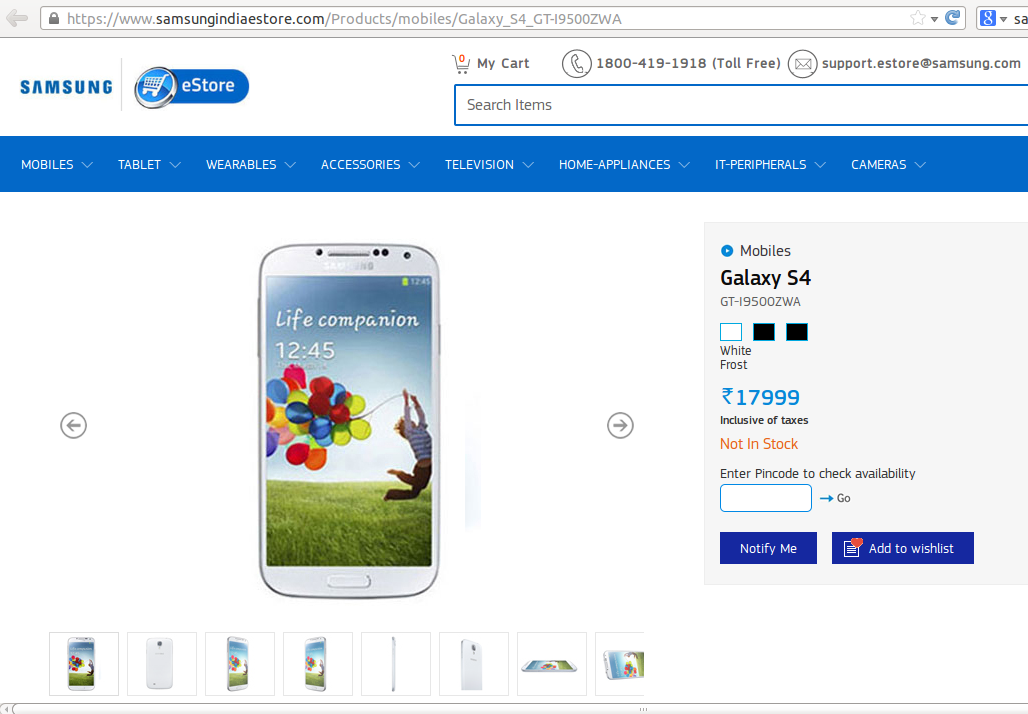
A promotional mail that landed in my Gmail inbox today carries a subject line that says Samsung Galaxy S4 available at Rs 17,999 @Amazon.

I click for more details and see a promotional offer by Amazon.in that says "You Save Rs 23,501" i.e. a huge discount of 57% with a Buy Now box just below it.


After clicking the Buy Now box, I am taken to the Amazon.in webpage that says maximum retail price (MRP) of the smartphone is Rs 23,500 and the deal price is Rs 17,999 thus giving me a saving of Rs 5,501 i.e. a 23% discount on MRP. 

So my discount or the money I save buying the smartphone online is already down from 57% to 23%.


Just to be sure that the 23% saving was for real, I decided to further dig into the pricing of the smartphone on the Samsung India eStore. And what do I find there?

The Samsung Galaxy S4 smartphone is being sold on the Samsung India eStore for Rs 17,999. While it also says 'Out Of Stock' it certainly validates the fact that the smartphone doesn't cost more than Rs 17,999 and that price is inclusive of all taxes.


What started as a promise of 57% savings on Samsung Galaxy S4 smartphone came down to 23% after checking out the deal on Amazon.in. A further due-diligence on its price gives out a completely different picture, which is 'That I Was Not Saving A Single Penny' buying the smartphone from Amazon.in.

I guess being a window shopper on the various eCommerce platforms has its advantages and disadvantages.
I am certainly not regretting because I see more advantages than disadvantages here :-)

Wednesday, 4 March 2015

Rajeev Menon is now COO of Marriott Intn'l for South-East Asia & Pacific region

Global hospitality major, Marriott International Inc. promoted Rajeev Menon
Rajeev Menon
as the chief operations officer (COO) for the South-East Asia & Pacific region.

Based out of
Singapore, Menon will be a key member of the continent’s senior leadership team and will function as the operational business leader for the region, under his new responsibility. He will also help drive key initiatives and ensure implementation of brand discipline programs.


Over the last 7.5 years, Menon was area vice-president - South Asia as well as Pakistan, Malaysia and Australia during various periods of his assignment. Menon has led the growth of India from six operating hotels in 2007 to 27 Marriott managed hotels operating under seven brands (with a pipe-line of another 49 hotels under construction). 

Under his leadership, Marriott has been recognised as one of the best performing international hotel brands in India and has received numerous best employer awards for the past several years. 

Menon joined Marriott in 2001 as the general manager of Renaissance Mumbai Hotel and Convention Center and Marriott Executive Apartments, Mumbai. In 2004, he moved to Sydney, Australia where he served as the general manager of Sydney Harbour Marriott and Country General Manager for Australia.

A global leading lodging company based in Bethesda, Maryland, USA, Marriott International currently has over 4,100 properties in 79 countries and territories and reported revenues of nearly $13 billion in fiscal year 2013.  The company operates and franchises hotels and licenses vacation ownership resorts under 18 brands.

Thursday, 27 March 2014

JWT set to acquire Social Wavelength

JWT, a leading global marketing communications brand and India’s leading integrated communications company, is set to acquire a majority stake in Social Wavelength, India’s leading social media agency. A full service agency, Social Wavelength specialises in social media offerings from strategy to executionand includes social media marketing, online reputation management, social CRM and social media for HR.

According to Hareesh Tibrewala and Sanjay Mehta, Joint CEOs, Social Wavelength, this acquisition is a logical confluence of social media and mainline expertise, coming together to create integrated communication for brands. "The rich experience of five years that we have, in this young industry of social and digital media, will find the next leap of growth, through this partnership. A socially connected world is going to create new challenges and opportunities for brands, and we will create solutions to help brands navigate those challenges,” the duo said.

Social Wavelength has established itself as India’s leading social media agency within a short span of five years. Founded in 2009, the agency now has over 170 professionals who offer social media communication services, social media listening services using Radian6, influencer outreach program, application development, video and rich media content creation and media buying to over 50 leading brands across their offices in Mumbai, Delhi and Chennai.

Colvyn Harris, CEO, JWT South Asia, said, “We want to be a critical resource partner across the many solutions we provide to our clients. As we continue to relentlessly transform our offerings, Social Wavelength adds a huge dimension to our existing clients and the brands we steward. Across the marcom value chain and across various digital touch points the skills and capabilities of Social Wavelength will be that edge.”

This acquisition will add value to JWT’s delivery capabilities across social media monitoring, online reputation management, digital ideation and production. JWT Asia Pacific has invested heavily in expanding its digital footprint over the last two years. In addition to the acquisition of Hungama, in India, JWT acquired Post Visual in South Korea in 2013, and took a stake in Converge, in Pakistan, in 2012. XM Asia, a digital agency owned by JWT, also acquired Designercity, in Hong Kong, and Thomas Idea, in Thailand, in 2013, and XM Gravity in 2012.

Monday, 17 March 2014

Glen Attewell replaces Sandeep Dhar as CEO of Tesco HSC

Tesco Hindustan Service Centre (Tesco HSC), the global technology and operations centre for Tesco operating out of Bangalore has appointment Glen Attewell as chief executive officer. He succeeds Sandeep Dhar, who spent over five years as CEO and is leaving the business.

In this role, Glen will work closely with the leadership team to continue the journey of Tesco HSC in becoming a fully integrated part of Tesco’s multichannel strategy. He will report to Alison Horner, Group Personnel Director, who serves on the Tesco executive committee.

Established in 2004, Tesco HSC is the operations and technology centre for Tesco, a leading global multi-channel retailer and is the first fully-owned retail operations centre set up at Bangalore, India by any major international retailer.
Currently employing over 6,800 people, HSC is an integral part of Tesco and drives value across IT, Business Operations, Finance, Property and Commercial Buying to Tesco’s operations globally.

Tesco is the world's third largest retailer and enjoys a market leader position in six of them. It has a turnover of £72.4 billion ($120.25 billion), operates around 6,784 stores and employs over 530,000 employees across 12 countries.

Friday, 28 February 2014

Voltas, Dow Chemical plan JV to tap water and waste water treatment market

Tata Group company, Voltas Ltd and Dow Chemical Pacific (Singapore) Pte Ltd, a member of the Dow Group Companies, are joining hands and forming an equal joint venture company in India. The proposed entity christened Voltas Water Solutions Pvt Ltd will tap the growing Water and waste water treatment market in the Indian subcontinent.

According to company officials, the JV will market and distribute standard packaged water treatment systems and waste water treatment systems of capacity up to 20 m3/hour. These systems will be primarily targeted at the residential and commercial complexes and, light industrial markets in the Indian subcontinent. The JV’s operations would include designing, procuring, testing, marketing, selling and servicing of such standard water treatment systems and waste water treatment systems.

Commenting on the development, Snehal Desai, Global Business Leader for the water and process solutions division of Dow Group, said, "Water treatment has significant business potential in India, and Voltas is an ideal partner with a strong brand reputation, and a wide-spread sales and service network. As part of our long-term strategy, we intend to establish the joint venture, to fully exploit the untapped potential of the Indian market."

Having identified water as a key focus area for the Tata group, Voltas officials said that Dow Group's unrivalled know-how and technological leadership in the water treatment space will help Voltas Water Solutions cater to the growing water treatment requirements of the Indian subcontinent. 

"The partnership will simultaneously leverage the brand and distribution strength of Voltas, along with the technology prowess of the water and process solutions division of the Dow Group. We will work towards establishing the joint venture as a leading provider of water treatment solutions," said Sanjay Johri, managing director, Voltas Ltd.

The water and waste water treatment market targeted by the new company is largely catered by unorganised players currently. The new joint venture, company officials said, will provide a branded and differentiated product line, with a focus on quality and service delivery.

Matrix Partners invests in MSME lender Five Star Business Credits

Matrix Partners India has led the first institutional round of funding in Five Star Business Credits (Five Star), a leading small business finance company that provides secured loans to micro and small enterprise customers (MSME). Five Star with its proprietary secured lending model has catered to more than 5,000 MSME customers over the last 5 years.

India has 29.8 million MSMEs and a further 30 million MSMEs in the unorganised sector. Formal banking and financial channels find it challenging to address the needs of MSME customers primarily due to the challenges in assessing credit quality of such customers. 

According to D Lakshmipathy, Managing Director, Five Star, MSME lending is a significantly underserved market in India not addressed by formal financial channels. "We have built a unique credit assessment model for deserving customers that run small but healthy businesses and all our loans are collateral backed. This round of funding from Matrix should help us further expand our branch footprint and enhance our funding base for long term expansion,” said Lakshmipathy.

Operators of small shop owners (provision stores, small restaurants, textile stores, bakery outlets, medical stores etc), small and medium machine shop operators, self employed people etc are key customers of Five Star that also provides loans for the purpose of home improvement to MSME customers. The company is present across 30 branches in Tamil Nadu and is planning to further expand its footprint across different states in India.

“Five Star has a highly differentiated, secured and sustainable lending model to address the large, underserved MSME financing opportunity. Financial services is an important focus area for the firm. We share Lakshmipathy’s vision and passion for this sector and look forward to being his partners in this journey,” said Rishi Navani, Managing Director, Matrix India.


A private investment firm Matrix Partners has Rs 3,000 crore under management and invests in companies targeting the Indian consumer market at the seed, early and early growth stages. It has a global network of funds investing in the US, China and India with $3 billion under management.

So far, Matrix Partners has invested in several market leading companies including Muthoot Finance (gold loan NBFC), TreeHouse Education (preschools), Cloudnine (maternity and infant care chain), Mswipe (mobile POS), Verse/NewsHunt (vernacular mobile platform) and Quikr (online classifieds).

Friday, 21 February 2014

Why should one invest in a residential property in Mumbai?

At the age of 23 when she had just started working, Shirin Gadbade acquired a ready-to-move, two-bedroom, hall, kitchen (BHK) flat in Pancham Apartments at Link Road, Borivali (West) for an all inclusive cost of around Rs 22 lakh.

Having fully paid back the bank loan taken to fund this acquisition in 2010, she decided to invest around Rs 80 lakh in another two-and-half BHK apartment at the Rustomjee Urbania development on the Eastern Express Highway in Thane (suburban Mumbai) in 2011.

“My mother coaxed me into buying the first flat. I figured investing in property was significantly rewarding when valuation of my apartment increased significantly by the time I'd paid off the home loan. Motivated, I decided on investing in another one for investment purpose and am hoping to replicate the success in the years to come,” she said.

A perfect example of creating wealth through investing in real estate, Shirin took possession of the second residential apartment sometime in 2012. While a large a large part of the total unrealised gains of around Rs 1 crore (majority from the first apartment bought 8-9 years ago) Shirin's real estate portfolio (of two apartments) is currently worth an estimated Rs 2.5 crore odd – all this at the age of 33.

Shirin is among the thousands of other like-minded people who took the plunge investing in real estate at various stages in the last decade or so and are reaping the benefits of this timely decision that helped create wealth.

Elaborating on the approach, Om Ahuja, chief executive officer – residential services, Jones Lang LaSalle India, said it is definitely possible to create wealth through real estate investment as long as one keeps the fundamentals in mind. “Effective investment in residential property requires a location to meet certain parameters. Fundamentally, the area should have good social infrastructure, availability of adequate public transport and sufficient economic activity to sustain development and growth. In order to mitigate most of the investment risk, one should restrict one’s residential property investment to Tier 1 and select Tier 2 cities.

“The investor should keep an eye on the market and sell the residential property at the right time in order to multiply wealth. If all the above precautions have been taken, the property should have appreciated at a consistent rate of 15% per annum for three years,” sid Ahuja adding that it is important to remember that one can almost never sell at the peak, just as it is impossible to always catch the lowest price.

Going by prices compiled by real estate rating and research firm, Liases Foras, different pockets in the Mumbai Metropolitan Region (MMR) and extended suburbs delivered a compound annual growth rate (CAGR) of 20% or more for investments made in 2005. Simply put people who bought real estate assets have seen their money multiply anywhere between 3.7 to 4.9 times depending on the market they invested then.

Lets now look at how prices have behaved in the years between 2005 and 2013. The Liases Foras data for the said duration shows, on an average, real estate prices in the island city rose from Rs 6,637 per square foot (psf) in January 2005 to Rs 30,344 psf in December 2013. In the central and western suburbs prices increased from Rs 3,005 psf and Rs 3,290 psf to Rs 12,418 psf and Rs 14,344 psf respectively in the same period.

In Thane and Navi Mumbai area, average prices grew from Rs 1,934 psf and Rs 1,730 psf in January 2005 to Rs 9,190 psf and Rs 6,475 psf in December 2013 respectively. The strong growth trend in real estate prices was also visible beyond the MMR region i.e. suburbs beyond Thane and Borivali, which saw per square foot rates shoot from Rs 1,055 and Rs 1,063 in January 2005 to Rs 4,571 and 5,237 in December 2013 respectively.

While realty market over the years has shown a lot of potential for investments, the overall economic environment in the recent past has changed thus raising questions as to whether wealth creation still holds true in the current scenario. Industry experts feel it does. “Intelligent investment into residential property still holds the potential of significant wealth creation. However, the market keeps changing and one needs to understand these changes,” said Ahuja.

So if you are keen on taking the plunge and investing your surplus in the residential property segment, following are some of the options in the MMR, according to Jones Lang LaSalle India that can be looked into for potential investments currently.

Bandra Kurla Complex (BKC): Currently quoting at Rs 27,500 psf to Rs 50,000 psf can double in 4-5 years time. Budget range from Rs 6 crore to Rs 25 crore. Walk to work concept, lesser supply and Central Business District are the key drivers .

Chembur / Tilak Nagar: Currently quoting at Rs 12,500 psf to Rs 20,000 psf can double in 3-5 years time. Budget range from Rs 2 crore to Rs 6 crore. Monorail, lesser supply and Santacruz Link Road are the key triggers.

Mahalaxmi / Jacob Circle: Currently quoting at Rs 20,500 psf to Rs 55,000 psf can double in 4-5 years time. Budget range from Rs 9 crore to Rs 25 crore. Monorail, gated community, lesser supply, south Mumbai profile like this area for race course view, eastern freeway are key triggers.

Ghatkopar / Chandivali: Currently quoting at Rs 12,500 psf to Rs 16,000 psf can double in 5-6 years time. Budget range from Rs 2 crore to Rs 5 crore. Closer to Powai where multi-national companies have offices, closer to metro, eastern freeway to get terminated at Ghatkopar junction, value for money at current price points.

Mulund / Bhandup / Ghodbunder: Currently quoting at Rs 10,000 psf to Rs 15,000 psf can double in 5-6 years time. Budget range from Rs 1 crore to Rs 3 crore. Better social infrastructure, better road connectivity and environmentally best in Mumbai.

“As for areas like Wadala, Lower Parel, Dombivli, Malad, Goregaon etc. there is enough supply that will hit the market where percentage appreciation will become a big challenge. Infrastructure is collapsing currently and don't see visibility of any major developments in terms of public transport and social infrastructure,” cautions Ahuja.

Thursday, 6 February 2014

HCL Corp forays into healthcare, launches India's first nation-wide networked multi-specialty clinics under HCL Avitas

HCL Corporation, the parent company of HCL Technologies and HCL Infosystems, has forayed into the healthcare sector with plans to be one of India's largest healthcare service providers. The new business entity, HCL Healthcare will address the entire spectrum of healthcare needs including providing healthcare delivery, innovative medical services, products and training to meet the growing need for quality healthcare.

Accordingv to Shiv Nadar, founder & chairman, HCL and Shiv Nadar Foundation, education, healthcare and technology will be the key enablers of India's future progress and growth. “Over the last 38 years, HCL has been at the forefront of technology and innovation. I have personally been committed to the cause of education through the Foundation for 20 years,” said Nadar adding that the company's entry into healthcare is an area of paramount national importance.

Kickstarting the venture, the company has launched a subsidiary called HCL Avitas in affiliation with Johns Hopkins Medicine International. Offering a of healthcare delivery offerings, HCL Avitas is positioned as India's first nation-wide networked multi-specialty clinics. The clinics will adopt global best practices for medical quality and training using evidence-based systems and integrating advanced technology to provide unmatched patient experience and outcomes.

Steven J Thompson, CEO, Johns Hopkins Medicine International, said, that HCL was a strong and trusted brand with a steadfast commitment to transform healthcare in India. “Together with HCL Avitas, we hope to establish a new paradigm in patient-centered care in India,” said Thompson.

HCL Healthcare observed that India has a shifting disease burden that is influenced by changing lifestyles and that this need is grossly underserved. “Our technology expertise and the ability to create scalable institutions will help us institute new benchmarks in healthcare delivery in India. Creating an organised technology-led health system that will be the long-term care partner is our immediate goal. HCL Healthcare intends to be that partner and provide patient-centered care for over 20 million people by 2020,” said Shikhar Malhotra, vice chairman, HCL Healthcare.

In the launch phase, HCL Avitas will establish a network of multi-specialty clinics across the country starting with the National Capital Region. Harish Natarajan, chief executive officer, HCL Avitas, said, “Technology is our strength – our clinics will all be networked giving patients access to their medical history and to the best specialists available in our system. Through our association with Johns Hopkins, we will bring in global best practices and the best evidence-based systems. In the next 5 years, we expect to have over 1500 doctors in our network across various cities in the country,” said Natarajan.

Wednesday, 22 January 2014

Banknotes issued prior to 2005 to be withdrawn: RBI Advisory


The Reserve Bank of India on January 22, 2014, advised that after March 31, 2014, it will completely withdraw from circulation all banknotes issued prior to 2005. 

In a note on its website, RBI said that from April 1, 2014, the public will be required to approach banks for exchanging these notes. Banks will provide exchange facility for these notes until further communication. 

The Reserve Bank further stated that public can easily identify the notes to be withdrawn as the notes issued before 2005 do not have on them the year of printing on the reverse side. (Please see illustration below)

 The Reserve Bank has also clarified that the notes issued before 2005 will continue to be legal tender. This would mean that banks are required to exchange the notes for their customers as well as for non-customers.

From July 01, 2014, however,  to exchange more than 10 pieces of Rs 500 and Rs 1,000 notes, non-customers will have to furnish proof of identity and residence to the bank branch in which she/he wants to exchange the notes.

The Reserve Bank has appealed to the public not to panic. They are requested to actively co-operate in the withdrawal process.

Friday, 17 January 2014

Ranbaxy's biggest bulk drug unit under US FDA scanner

This story first appeared in DNA Money edition on Tuesday, January 14, 2014

Troubles do not seem to end for Ranbaxy Laboratories, which saw its shares tank 9.47% on Monday after one of its key facilities at Toansa, Punjab, was slapped with Form 483 by the US Food and Drug Administration (FDA).

Form 483 is issued at the conclusion of an inspection when investigators observe any conditions that in their judgment may constitute violations of the Food Drug and Cosmetic Act and related Acts.

The shares of Ranbaxy, the biggest Indian drugmaker by sales, opened at Rs 466 on Monday and reached a low of Rs 420 before closing the day at at Rs 438.80,  down 5.58% from the previous close.

This is the second biggest fall since September 2013 when the stock had lost 30.27% of its value following an import alert on its Mohali plant by the US FDA for violation of current good manufacturing practices.

In a note to the exchanges, Ranbaxy said, “It is assessing the observations, and will respond to the US FDA in accordance with the agency’s procedure to resolve the concerns at the earliest.”

While Ranbaxy management did not share any production related details, industry experts said the plant manufactures around 70-75% of its API requirements.

Under the Form 483 process, the company would now have to respond with its corrective action plan and implement it expeditiously or face an import alert.

Sarabjit Kour Nangra, vice-president, research-pharma, Angel Broking, said, “During the second quarter of calendar year 2013, its other key facility at Mohali came under US FDA import alert. With this plant also under scanner, it would have impact on the operations of the company in the US, unless it can compensate for the same at the earliest and mange a smooth supply of key raw materials,” said Nangra.

She said more clarity is awaited from the Ranbaxy management in order to ascertain the exact impact on the financials, especially operating profit margins.

“Until then, the company could trade at a huge discount to its peers,” said Nangra.

Getting US FDA clearance will be crucial for Ranbaxy considering all of its India-based factories are currently banned by the regulator from exporting medicines to the US, its largest market.

Last week Ranbaxy inked a licensing pact with EPIRUS Switzerland GmbH for BOW015, a biosimilar version of Infliximab, prescribed to treat rheumatoid arthritis, and said the product will be introduced in India and other emerging markets.

Ranjit Kapadia, senior vice-president - pharma, Centrum Broking, said the molecule has only completed Phase 3 studies. “It would take 12-18 months to get regulatory approval and commercialise the product in India,” he said.

Will Wockhardt turn rocket for its lone Mutual fund believer?

My colleague Nupur Anand is the lead writer of this story appearing in DNA Money edition on Monday, Janart 13, 2014.

Last time when the Wockhardt shares shot up a whopping 350% was in 2012 after the drug firm successfully came out of debt restructuring.

This time buffeted by issues with the US Food and Drug Administration, the stock is again in doldrums -- between April and December it lost 83%, down to a new low of Rs 339.85 from Rs 2,024.90 at the start of the fiscal.

And now rooting for an encore is Prashant Jain, chief investment officer of HDFC MF, India’s largest fund house, who known for taking contra calls and unusual bets that have paid off.

As Wockhardt stock nosedived, several retail investors and mutual fund houses started dumping it.

In the same period, Jain quietly picked up the pharma firm’s shares.

Till April last year, HDFC MF had zero shares of Wockhardt, whereas other mutual funds held 10.34 lakh shares.

By September end, HDFC has 13.59 lakh shares, a whooping 97% of the total shares held by mutual fund houses.

Out of the total 1.36% shares of Wockhardt held by MFs, Jain alone holds 1.29%.

Under Jain’s watch, the asset under management of HDFC MF have grown to mammoth size of Rs 108,990 crore.

And market experts believe that this contra call by Jain may pay off.

An expert with a foreign brokerage said, “The rationale behind Prashant Jain’s optimism has to do with his philosophy on finding deep value stocks which he can hold, and expect higher value to unravel when it tides through difficult times. To me, the recent stock correction factors a worst-case scenario.”

A pharma analyst from a leading domestic brokerage added, “Fundamentally, despite trouble with US FDA, the residual business would have enough earnings power to justify current price. The current balance-sheet health is much stronger than ever, and hereon there can only be upside to earnings outlook. The kind of turnaround Prashant Jain has seen in Aurobindo could be something he is betting on in case of Wockhardt, once the regulatory issues are tackled.”

Bad times for Wockhardt started in May after the USFDA put an import alert on its Waluj plant and intensified between May and November, when the company being hauled up four more times by the US and the UK drug regulators.

Sarabjit Kour Nangra, VP-research, pharma, Angel Broking also believes that Jain’s bet may pay off.

“The Wockhardt stock took significant beating last year and has probably gone through the worst times. But one needs to also take into account that the company successfully came out of the financial mess in the years before that and Jain is certainly betting on its revival from the US FDA and UK Medicines and Healthcare Products Regulatory Agency issues,” said Nangra.

“One also needs to remember that Wockhardt is one of the biggest players in the pharma industry and investors with a long-term view would certainly take exposure as the risk-reward is huge,” she said.

Wockhardt stock has been recovering slowly and is now trading at Rs 424.95, already up 25% from the December low of Rs 339.85.

Wockhardt’s foreign drug regulator alerts

May 2013 - US Food and Drug Administration import alert on Waluj Plant

July - UK Medicines and Healthcare Products Regulatory Agency (UK MHRA) import alert on Waluj plant

Oct - UK MHRA withdraws Good Manufacturing Practice (GMP) certificate for Daman plant

Oct - UK MHRA withdraws GMP for Chikalthana plant

Nov - US FDA import alert on Chikalthana plant

Dec - US FDA import alert on Chikalthana and Waluj units for veterinary drugs